The Brand Manifesto:
Artist Statement
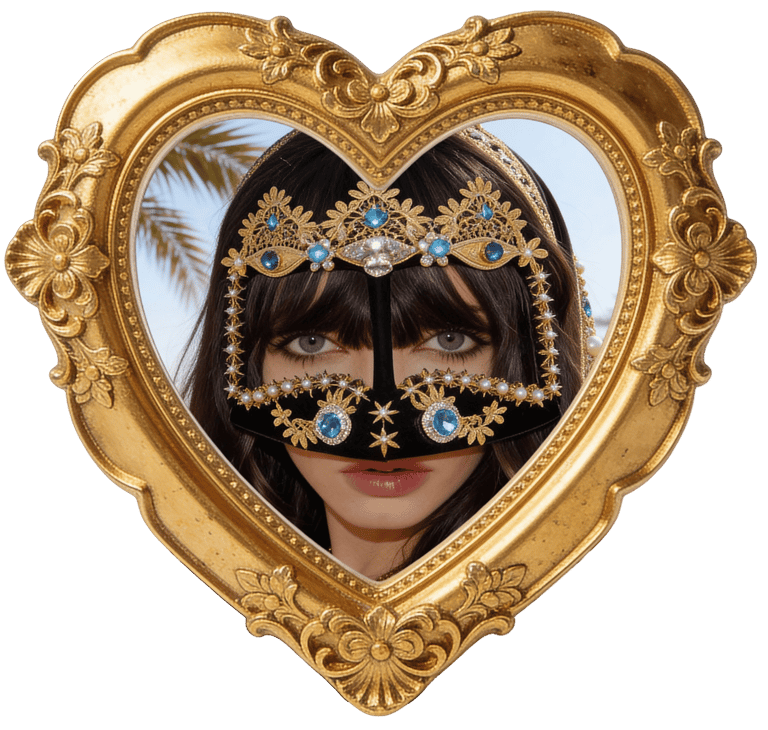
The "Burqa"—the historic face-mask worn by Arabian women—is a profound piece of cultural heritage that has been wrongfully accused globally as a symbol of religious oppression. In truth, the Burqa is entirely cultural, not Islamic. Historically, it served as a beautiful, celebratory rite of passage, signifying a woman who was married or soon-to-wed, while offering elegant privacy and protection for the woman from the sun, and protection from male strangers' praying eyes.
To correct this international misconception and invite the world to appreciate its profound aesthetic value, designer Abeer Mohammed has transformed the traditional Burqa into a piece of handmade, wearable avant-garde art. By preserving its iconic silhouette while infusing it with contemporary luxury, Burqa Abori bridges the gap between historical preservation and global high fashion.
A Regional Tapestry:
The Cartography of the Burqa
Historically, the Burqa was a rich visual language spoken across the Middle East. One glance at a woman's burqa could instantly tell you her nationality, as each country's burqa possessed a unique silhouette, color palette, and material composition that mirrored its distinct local culture.
Tragically, over the decades, this cultural fashion piece and expressive cultural art form faced absolute extinction across the Arab world. It vanished from daily life and celebrations alike—except in the United Arab Emirates, preserved through the disruptive vision of designer Abeer Mohammed through "Burqa Abori".
The Renaissance:
From "Grandma Style" to Haute Couture
When Emirati designer Abeer Mohammed first began her creative crusade, the Burqa was on the brink of erasure. It was worn only by a few elderly women in UAE, and society dismissed it, labeling it as "grandma style."
Refusing to let this cultural DNA extinct, Abeer insisted on reviving it and preserving it for future generations. Abeer looked at the traditional face-mask not as a relic of the past, but as a canvas for the future. She began reimagining the Burqa through the lens of global high fashion, channeling the theatrical drama of Alexander McQueen, the timeless elegance of Chanel, the opulent maximalism of Dolce & Gabbana, the structural power of Balmain, and the luxury of Christian Louboutin.
The Birth of the Burqa Industry
What started as a singular artistic rebellion catalyzed an entire industry. Abeer expanded her vision from wearable face-art to printing her signature Burqa designs onto contemporary T-shirts, breaking the boundary between traditionalism and modern streetwear. In addition to that, she created Burqa-themed home decor, stationary accessories, and souvenirs.
This spark caught fire. Local designers and home-based small businesses began emulating her concepts, copying the prints, and integrating the Burqa into modern lifestyles and products. Today, because of "Burqa Abori", the Burqa has experienced a magnificent cultural awakening. It is no longer hidden in old photographs; it is proudly flaunted at national celebrations, weddings, and special occasions, and its imagery graces luxury lifestyle items, and accessories from mugs to books. Imitation of "Burqa Abori" became the ultimate vehicle for cultural preservation.
The Exclusivity
True luxury lies in rarity. All designs are entirely handmade by Abeer Mohammed. A select few are one-of-a-kind collectibles created exclusively for princesses and global celebrities, while the main collections are strictly limited-edition and made-to-order.
Every "Burqa Abori" design features a premium fabric base, meticulously adorned with an eclectic mix of elements: from organic wood and structural metals to delicate feathers, glass, precious stones, Swarovski and zircon crystals, and lustrous pearls.
Meet the Designer
Abeer Mohammed: Creator of "Burqa Abori"
In the realm of high fashion, Abeer creates under her childhood moniker, "Burqa Abori." This endearing name was originally given by her relatives to the whimsical burqa designs she used to craft as a young girl. Today, it stands as a testament to her purest, most instinctive creative soul—where her lifelong obsession with preserving this cultural symbol first began.
Abeer "Bint Daddy": The Director
Abeer's cinematic journey breathes through a different nickname; "Bint Daddy" (Dad's daughter). Growing up as a child of mixed heritage—born to an Emirati father and a Canadian mother—Abeer’s unique features and skin tone often stood out from her relatives. This frequently prompted curious onlookers to ask her, “Inti min bintah?” (Whose daughter are you?).
With sweet, childlike innocence, she would always reply, "Bint Daddy" (Daddy's girl / My father's daughter). The affectionate title stuck with her for life. Today, when she steps behind the camera as a film Director, she proudly goes by "Bint Daddy"—a profound tribute to her dual Arabian and Canadian cultures, her lineage, and the deeply rooted ancestral identity that anchors her avant-garde cinematic and artistic vision.
Contact التواصل

Burqa Abori برقع عبوري
Contact التواصل
Join BuRQA Abori إنضمي إلى برقع عبوري
Email: البريد الإلكتروني
Abori@BurqaAbori.com
WhatsApp: واتساب
(+1) 343-7000-401
© Burqa Abori by Abeer Bint Daddy 2026. All rights reserved.
The Burqa is a form of fashion not oppression
البرقع هو جزأ من الزي التراثي وشكل من أشكال الأزياء وليس إضطهاداً للمرأة